CESDR Disaster Resilient Unit (DRU) held a Round Table Discussion with University of Huddersfield (HUD), UK professors, Dr. Dilanthi Amaratunga and Dr. Richard Haigh and HUD Researcher, Dr. Nuwan Dias on March 26, 2019, 5:30 - 7:00 PM at DLSU Velasco Hall V512.
Dr. Andy Oreta, OIC of the CESDR DRU first presented an update on the unit's recent activities and on the Newton - Agham Workshop on Localising Strategies on Making Cities Resilient to Disasters which was co-organized with HUD last Jan 2017. Dr. Nuwan Dias presented their project which focuses on Strategies and Challenges on DRR-CCA intergration. An open discussion followed after where Dr. Mike Promentilla served as facilitator.
Dr. Alvin Cukaba, CESDR Director, Dr. Lessandro Garciano (CE Dept. Chair), Dr. Alvin Chua (ME Dept. chair) Dr. Tarroja (SDRC Director) and Dr. Marlon Era (Faculty of BSD and PH Chair of the CABARET project) attended the forum. Members of the CESDR DRU supported the event.
The RTD resulted on plans for future collaboration. An MOU was suggested to be formulated. Prof. Dilanthi and Prof. Haigh have future proposals and they will explore a collaboration with DLSU.
Sunday, March 31, 2019
Monday, March 25, 2019
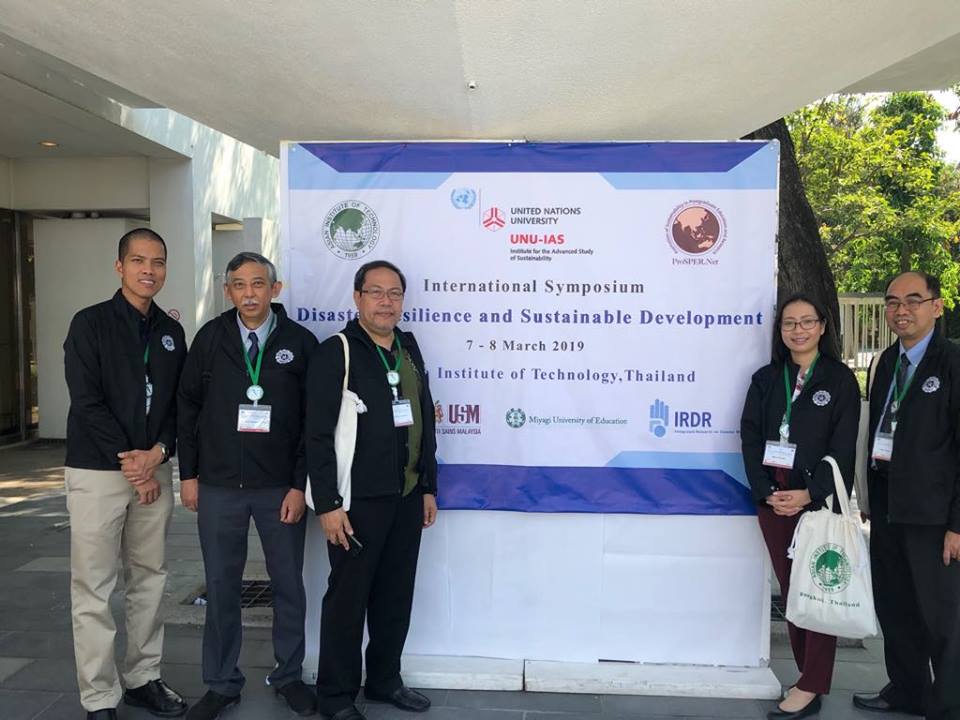
CESDR Disaster Resilience Unit Members at DRSD2019 - AIT
![]() |
| CESDR DRU members: Materum, Oreta, Tanhueco, Redillas & Mutuc |
- Developing teaching and learning modules for a disaster readiness and risk reduction subject –Authors: Renan Tanhueco (Presentor) and co-authors: Andres Oreta, Jose Edgar Mutuc, Edgar Vallar, Lessandro Garciano, Mary Geraldine Yumang and Efren DeLa Cruz
- Identifying research interventions on resilience building using the ten essentials for “making cities resilient” global campaign – Authors: Andres Oreta (Presentor), and co-authors: Mario De Leon, Jose Edgar Mutuc, Renan Tanhueco, Lawrence Materum and Marla Redillas
- Investigation on the potential of LID in urban land uses in the Philippines – Author/Presentor: Marla Redillas
- Data visualization and analytics: a System Dynamics approach - Author/Presentor: Jose Edgar Mutuc
- Sensor Node Positioning and Fractional Data Sampling for Risks Prevention, Recovery, and Adaptation of Wireless Sensor Networks to Different Disaster Scenarios – Author/Presentor: Lawrence Materum
The DRSD2019 was organized by the Disaster Preparedness, Mitigation and Management of AIT. It was also co-organized by the United Nations University, Prosper.net, Miyagi University of Education, Keio University, Universti Sains Malaysia and IRDR.
| Dr. Tanhueco |
| Dr. Oreta |
| Dr. Mutuc |
| Dr. Redillas |
Monday, February 4, 2019
Introducing CESDR Disaster Resilience Research Lab
The Center
for Engineering and Sustainable Development Research, or CESDR is the research arm of the DLSU-Manila Gokongwei College of
Engineering (GCOE). CESDR has several subcenters or research labs including the Subcenter for Disaster Risk Reduction (DRR) and Climate Change Adaptation (CCA). To address the broad issues on DRR and CCA, the subcenter is renamed as CESDR Disaster Resilience Unit. - VISION: The research lab envisions itself as a resource to country actively engaged in resilience building in communities, their built and natural environment through disaster risk reduction and climate change adaptation.
- MISSION: The research lab aims to advance knowledge, conduct research and promote best practices in resilience building though disaster risk reduction and climate change adaptation, especially involving complex environments.
This brochure introduces the profile of the members and their research interests. We welcome research collaboration and networking that promote resilience building of cities and communities.
CESDR CONTACT INFORMATION:
- Dr. Andres Winston Oreta (OIC of the Research Lab)
- Email: andres.oreta@dlsu.edu.ph
- Ms. Kriezl “K-Ann” Esurena (Secretary),
- Email: kriezl.esurena@dlsu.edu.ph,
- Tel: (632) 5244611 loc. 275
Friday, February 1, 2019
CESDR Disaster Resilience (DRR-CCA) members as Organizers of the Newton Agham Workshop
| The Organizers of the Newton-Agham International Workshop on Localising Strategies for Making Cities Resilient to Disasters (22-26 January 2018) |
![]() |
The Particiipants of the Newton-Agham International Workshop on Localising Strategies for Making
Cities Resilient to Disasters (22-26 January 2018)
Under the British Council’s Researcher Links scheme offered within the Newton Fund and supported by the Dept. of Science and Technology (DOST) and PCIEERD, the international workshop on "Localising Strategies for Making Cities Resilient to Disasters was successfully organized by the faculty and staff of De La Salle University and University of Huddersfield last 22nd to 26th January 2018 at the Century Plaza Hotel, Manila, Philippines. The CESDR DRR-CCA members - Dr. Oreta, Dr. Tanhueco, Dr. Mutuc, Dr. De Leon, Dr. Redillas, Dr. Materum, Dr. Garciano and Engr. Galupino formed the local organizing committee of the workshop.
|
Monday, December 4, 2017
CESDR DRR-CCA members attend 7ICBR - Bangkok
| Dr. Mutuc, Dr. Juanzon and Dr. Oreta |
CESDR subcenter on DRR-CCA members, Dr. Andres Oreta and Dr, Jose Edgar Mutuc attended the
7th International Conference on Building Resilience (7ICBR) held on
November 26-29, 2017 in Bangkok, Thailand. Two papers with Dr. Oreta as co-author were presented - First
author, Dr. Joseph Juanzon presented the paper on “An assessment on the effective preparedness
and disaster response: The case of Santa Rosa City, Laguna.” while Dr. Oreta presented the paper co-authored with
Engr. Rizalyn Illumin on “A
Post-Disaster Functional Asset Value Index for School Buildings.”
Dr, Mutuc and his MSIE PhD advisee, M. Gutierrez presented their paper on "A model for humanitarian supply chain: an OR approach."
The conference is part of the activities under the URCO RPW on Building Resilient Cities & Communities. Hence, on
November 28, 2017, a meeting with UK partners in the Newton Fund Research
Links was held. Dr. Jose Edgar Mutuc and Dr. OretaI met Prof. Dilanthi Amaratungga,
Prof. Richard Haigh and Dr. Ezri Hayat University of Huddersfield University (HUD) to
discuss the incoming workshop on January 22-26, 2018 which will be held in Manila with CESDR members as the organisers. Dr.
Mutuc and IDr. Oreta also attended the workshop on ESPRESSO – Enhancing disaster risk
reduction and climate change adaptation strategies for disaster prevention.
Interesting Poster at the 7ICBR by Prof. Dilanthi et al:
Monday, October 30, 2017
Round Table Discussion with Albay DRRM Stakeholders
CESDR DRR-CCA members, Dr. Beng Manalang, Dr. Andy Oreta and SOE Dean Dr. Tess Tiongco attended a round
table discussion with Albay DRRM Stakeholders. It was conducted
last August 31, 2017, at 4 in the afternoon. The objective of this round table
discussion was to identify the area of strength of the Albay Province and
possible areas for collaboration in the future, further it focused on the
integration of DRR in research to understand requirements and products of research
and its scientific study. Read related blog on Albay Networking.
During the discussion, areas where
focused on:
- Policies among LGU, included are legal bases for making written mandates and laws, which are CCA and DRR centered.
- Community based impact evaluation that needs to incorporate DRR mgt. and CCA adaptation ; it was also discussed that programs implemented needs to be evaluated and formulate new programs if one is not successful. This would also allow the use of the developed tools of DLSU.
- Encouraging LGU to coordinate with NEDA on growth modeling that are sustainable, environment focused, public safety is considered, was also looked into as the LGU needs to look for funding.
- As per suggestion of Dr. Daep possible areas for collaborations needs to be focused on the concept of BUILD BETTER PRINCIPLE, as it is long term solution. Further Dr. Daep, made an emphasis on training LGU officials and empowering them with deeper understanding of their roles in legislation and implementation.
- . A workshop was conducted where in each Department present during the discussion were asked to present areas that are researchable and is the focused of the LGU.
6.
a.
For the Agriculture
Department, areas identified as researchable were the following:
i.
Development of rice variety that is Albay
Climate Resilient, this is aimed at making rice production sustainable.
ii.
Since Albay is an agricultural province it is
deemed important that climate proofing of post harvest area is needed.
Irrigation needs also to be looked into.
iii.
Impact Evaluation: Better tools based –policies
on retrieval of crops
b.
Social Welfare
i.
Effects of DRR on vulnerable sectors with
consideration to the socio-cultural
ii.
Incidence of gender based violence to displaced
families.
iii.
Impact of service delivery to displaced families
iv.
Training on Psychological management
c.
Albay Provincial Health Office
i.
Facility based improvement, since majority of
the hospital in the Province have been improved for better services. Structures
that were old and dilapidated were retrofitted. However, there are still few
structures that need to be climate change resilient and disaster proof.
ii.
Health Service providers must be empowered
through training and kept abreast with the DOH programs yet locally focused.
d.
Academe (represented by Bicol University
external affairs officer Prof. Weng Zoilo)
i.
As CCA and DRR has been discussed often to
students; it is important that a policy needs to be put into place that would ensure that the LGU
and schools, colleges and universities will be able to come up with a module
which are focused on climate change and disaster risk reduction management.
ii.
Modules that are formulated must be piloted and
downloaded to various schools for pilot testing
iii.
The Professors must guide their student and give
them the title for their thesis, topics that deals with climate change
adaptation and mitigation and disaster risk reduction needs to be looked into
by the advisers.
e.
LGU:
i.
A conduct of seminar on associated hazards and
impact to the government, including its RDNA and PDANA must be looked into.
Also the consideration on having a Critical resource assessment per LGU and
profiling of resources, and having it available in an electronic file would
facilitate easy use of the critical data.
ii.
Sustainability of CCA and DRR programs requires
the institutionalization of CCADRRMTI. Module
development and formulation of trainings for the local executives will be one
of the activities of the CCADRRMTI.
Other matters discussed during
the round table discussion were, aimed at identifying areas for possible
collaboration with DLSU.
1.
Development of evaluation tools that are
specific to their respective agencies and are CCA-DRR centered.
2.
Another matter discussed was the conduct of
training among LGU and their personnel on the formulation of proposal to ensure
that proper funding be given.
3.
The health sector must come up with a critical
resource identification and strengthening of LGU , which is more specific for their locality.
Contextualizing a tool and CCADRR program that is
centred on the health sector has become challenging since the National
government, through the Department of Health download their programs to the
LGUs, it is in this context that some LGU programs for the Health sector are
not given much focused. It is therefore important that the DOH and LGU must
come up with the possible collaboration of making CCA-DRR in the health sector
CCA-DRR specific.
4.
Also, it was identified during the discussion
the training needs:
a.
LGU executives on their roles on CCA and DRR
b.
Forecasting
c.
Policy writing
d.
Media relation
e.
Zero Casualty
f.
Resource Identification
Documented by
Joan Evasco - Lagco
Photos during the workshop and the outputs
Friday, September 1, 2017
Networking with Albay DRRM Stakeholders
![]() |
| The participants in the round table discussion |
![]() |
| Dr. Cedric Daep |
The round table discussion followed the program below:
- 300-315 pm - Introduction of Participants
- 315-330 pm - Introducing CESDR & DRR-CCA Subcenter by Dr. Andy Oreta (CESDR DRR-CCA member, DLSU CE Dept)
- 330 -345 pm - Incorporating DRRM & CCA to the Community-based Impact Evaluation of LGU Interventions by Dr. Tes Tiongco (Dean, DLSU School of Economics)
- 345-400 pm - Areas for Collaboration & Workshop by Dr. Beng Manalang (CESDR DRR-CCA member, DLSU IE Dept)
- 400-430 pm - Areas for Linkages by Dr Cedric Daep, Chief of the Albay Public Safety and Emergency Management Office (APSEMO)
- 430-530 pm -Discussions
![]() |
| Dr. Tiongco presents her research during the round table discussion |
![]() |
| A workshop was also conducted during the round table discussion |
Subscribe to:
Posts (Atom)